
The IQ test scale is a way of grouping intelligence test results based on an IQ score. It helps explain how your result compares with the general population, using age-based reference groups. The scale is not used to judge personal value, but to describe a score’s statistical position.
IQ scores come from standardised tests that assess cognitive skills such as logical reasoning, verbal comprehension, numerical reasoning, and spatial reasoning, then compare performance with a larger group of people of the same age.
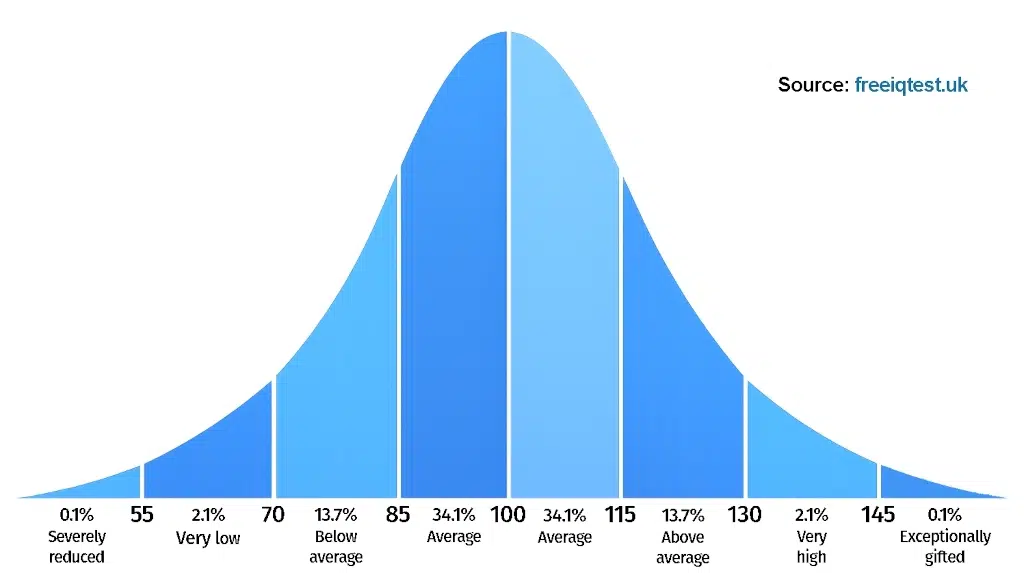
How the IQ test scale works
The IQ test scale is based on a statistical model called the normal distribution, often illustrated as a bell curve. On most modern tests, the average score is set at 100, which represents the midpoint of results in the reference population. Most people score close to this average, while very low and very high results are less common.
A key part of the IQ test scale is the standard deviation. On many widely used IQ scales, the standard deviation is 15 points. This spread is what makes a large share of the population fall between 85 and 115 on the IQ test scale.
Scores further from the average become progressively rarer, which is why extremely high or low results are best understood in a statistical context rather than as fixed labels.
The IQ test scale is a relative measure, not an absolute one. A score does not represent a fixed amount of intelligence in isolation. Instead, it shows how your performance compares with other people in your age group.
This is also why age-based norms matter: the same raw performance can translate to a different IQ score depending on age group comparisons.
IQ test scale ranges
| IQ range | Cognitive range | Share of the population |
|---|---|---|
| 0 – 54 | Severely reduced | 0.1 % |
| 55 – 69 | Very low | 2.1 % |
| 70 – 84 | Below average | 13.7 % |
| 85 – 114 | Average | 68.2 % |
| 115 – 129 | Above average | 13.7 % |
| 130 – 144 | Very high | 2.1 % |
| 145+ | Exceptionally gifted | 0.1 % |
IQ test scale ranges describe how common a score is within a population, not what someone can or cannot do in everyday life.
They do not directly measure creativity, emotional intelligence, social skills, motivation, or practical judgement. For that reason, ranges should be treated as broad categories that help interpret where a score sits on the scale.
Range labels can vary slightly between tests and publishers, but the following IQ test scale overview is commonly used as a general guide.
These categories reflect statistical frequency rather than personal potential. A score can be influenced by factors such as test design, time pressure, and the testing environment, so interpretation is always stronger when combined with context.
Why percentiles matter on the IQ test scale
An IQ score is often easier to understand when paired with a percentile. A percentile describes the percentage of people in the reference group who scored the same or lower than you.
For example, a higher percentile indicates your score is above a larger portion of the comparison group. Percentiles are useful because they translate the IQ test scale into a more intuitive ranking within the population.
In practice, the IQ test scale and percentile ranking work together: the scale provides a standardised score, while the percentile provides an easier-to-grasp position within the distribution.
Differences between tests and limitations of the IQ test scale
Not all IQ tests measure abilities in exactly the same way. Some put more emphasis on verbal comprehension, others focus more on non-verbal reasoning, such as patterns and spatial relationships, and some combine several sub-scores into a single overall score.
Because of these design differences, two tests can produce slightly different results for the same person, especially if one test matches a person’s strengths more than another.
The IQ test scale also has clear limits. It focuses on certain cognitive processes and does not attempt to measure the full range of human intelligence.
Creativity, emotional understanding, interpersonal skills, real-world decision-making, and practical knowledge are not captured by a typical IQ test scale.
Even within cognitive performance, factors such as fatigue, stress, distractions, and motivation can affect how well someone performs on the day.
For these reasons, an IQ test scale result is best treated as an informative snapshot rather than a definitive judgement. If you want the most useful interpretation, consider the score as one data point alongside other indicators of learning, problem-solving, and everyday performance.