
Albert Einstein is one of the most recognisable scientific figures in history, so it is natural that people wonder how his mind would “score” on a standard intelligence test.
That curiosity has helped popularise the search term Albert Einstein’s IQ, but it also creates a problem: there is no verified public record of an IQ test result for him.
Because of that, most numbers you see online are not measurements. They are retrospective guesses based on reputation, academic achievements, and the way IQ scores are discussed in modern culture.
This article keeps the focus on what can be supported with reasonable caution, and why context matters more than a single headline figure.
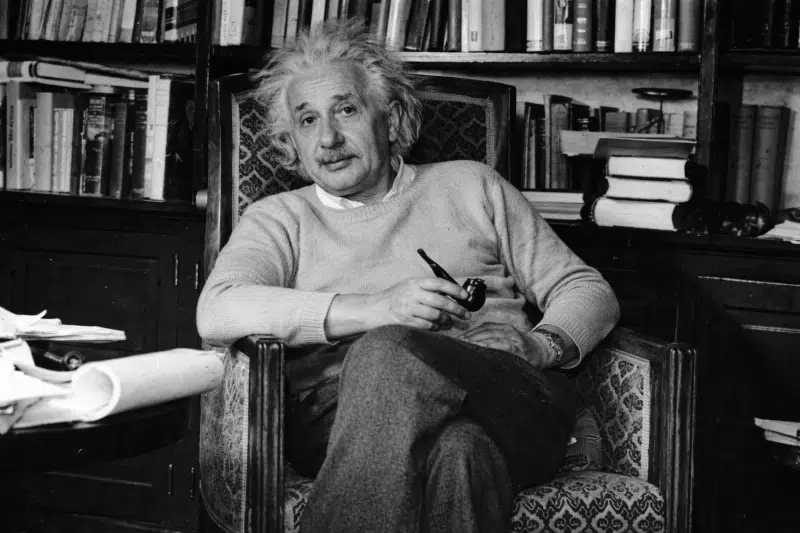
Albert Einstein’s IQ estimates and common claims
Many websites repeat figures such as 160 or higher when discussing Albert Einstein’s IQ. The issue is that these values are typically presented without primary documentation, test details, or any reliable chain of evidence.
In practice, they function more like a shorthand for “exceptionally intelligent” than like a confirmed score from a standardised assessment.
A more responsible way to read these claims is to treat them as informal estimates, not facts.
Einstein’s published work strongly suggests extraordinary abstract reasoning and problem-solving ability, but IQ is a specific measurement tool with specific conditions, and we do not have the kind of testing record that would allow a precise number to be confirmed.
Albert Einstein’s IQ and why there is no official score
When people ask about Albert Einstein’s IQ, they usually expect a single number. The reality is simpler and less satisfying.
There is no widely accepted public record showing that Einstein ever took a modern standardised IQ test and no verified document that reports a score.
Modern IQ tests were still developing during Einstein’s lifetime. Even if he had taken an assessment, the scoring norms, test formats, and reference groups would not match what people mean today when they talk about an IQ score on a contemporary scale.
That is why most “confirmed” numbers you see online should be treated as speculation.
What we can infer from Einstein’s achievements
Even without a test score, Einstein’s work gives strong clues about the kinds of cognitive abilities he likely had in exceptional measure.
Abstract reasoning and conceptual thinking
Einstein’s breakthroughs relied on building new conceptual frameworks, not just applying known formulas.
That points to unusually strong abstract reasoning, the ability to work with mental models, and comfort with counterintuitive ideas.
Mathematical thinking and structured problem solving
While Einstein is sometimes portrayed as a lone genius who only “imagined” his way to discoveries, his work required disciplined technical reasoning and collaboration with the mathematics of his time.
High-level problem-solving in physics typically reflects strong pattern recognition, logical structuring, and the ability to hold multiple constraints in mind.
Verbal and explanatory skill
Einstein’s popularity also came from his ability to explain difficult ideas in accessible ways. IQ tests only partly capture that.
Clear explanation involves communication, intuition about what confuses people, and the skill to simplify without losing meaning.
Although specific IQ numbers for Einstein are mostly internet folklore, there are a few recurring reasons why exact figures keep circulating.
No primary source
A credible IQ claim needs documentation: the test name, date, administrator, scoring method, and the reported result. Those details are almost always missing.
Retroactive scoring does not work cleanly
It is tempting to take a person’s achievements and “convert” them into an IQ number. That is not how IQ is designed.
IQ is a normed score based on performance relative to a reference group under controlled conditions.
Achievements depend on more than cognitive ability alone, including education, time, opportunity, and persistence.
Confirmation bias and celebrity maths
People like simple rankings. A single number is easy to repeat and share, especially when it confirms a cultural narrative about genius.
You will often see Einstein grouped with Isaac Newton and Stephen Hawking in IQ discussions.
The comparisons usually imply that all three would land in an “extremely high” range, sometimes above 160.
The most careful conclusion is that these comparisons are symbolic rather than scientific.
They are a way for people to express that these scientists operated at an extraordinary level of reasoning and originality. But there is no reliable scoreboard that lets us rank them by IQ with confidence.
If you want a clearer picture of what ranges mean, it helps to read what IQ is and then look at the IQ test scale to see how scores cluster and how small differences in averages can be overstated.
Key takeaways
- There is no verified public IQ score for Einstein, so exact numbers should be treated as unconfirmed claims.
- Einstein’s scientific work strongly suggests exceptional abstract reasoning and problem-solving ability, but IQ is only one lens.
- Comparisons with Newton and Hawking are mostly cultural shorthand, not evidence-based rankings.
Conclusion
So, what should you believe about Albert Einstein’s IQ? The most accurate answer is that we do not have a confirmed score, and we do not need one to recognise the scale of his intellect.
Estimates exist because people want a simple metric for genius, but Einstein’s legacy is better understood through his work, his methods of thinking, and his long-term impact on science.
If you are curious about extremes more broadly, you may also enjoy our article The highest IQ in the UK, which explains why popular IQ headlines often mislead and how context changes everything.