
Nikola Tesla is widely regarded as one of the most original and influential inventors in history. His work in electricity, electromagnetism, and power systems left a lasting mark on the development of modern technology.
Because of his extraordinary creativity and distinctive way of thinking, there is ongoing interest in Nikola Tesla’s IQ and how high his intelligence may have been.
Most discussions about Nikola Tesla’s IQ are based on later interpretations of his achievements, because modern IQ tests did not exist during his lifetime.
Even so, Tesla is often cited as an example of exceptional intelligence that goes beyond typical expectations.
The aim of this article is to clarify what can reasonably be inferred about Nikola Tesla’s IQ based on historical context and verifiable facts.
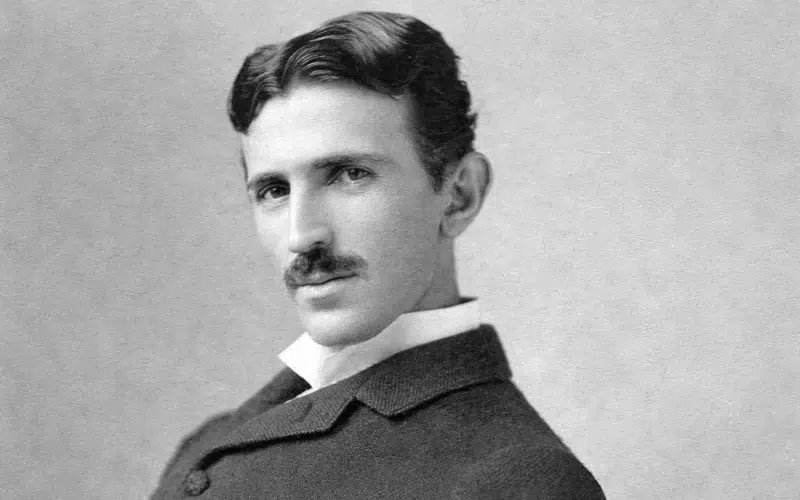
Nikola Tesla’s IQ estimates and internet rumours
When searching for Nikola Tesla’s IQ, you will often come across claims that his IQ was as high as 310.
These statements are most common online and in popular articles, but there is no reliable historical or scientific evidence to support them.
They are best understood as internet rumours and exaggerated theories, usually driven by misunderstandings of what an IQ score represents.
In Tesla’s era, standardised IQ tests as we know them today had not yet been developed. For that reason, his IQ cannot be determined in the same way it can for modern individuals.
More serious estimates, typically based on comparisons with other exceptional scientists and inventors, place Nikola Tesla’s IQ somewhere roughly between 160 and 200.
Even that range would indicate an extremely high level of intelligence, found in only a very small part of the population.
Estimates in this range fit with Tesla’s widely reported strengths in visual thinking, rapid understanding of complex technical problems, and creative connections between ideas.
It is still important to stress that these figures are approximations. Tesla’s legacy is defined by his inventions, innovative thinking, and long-term impact on science, not by any specific number on an IQ test scale.
What a high IQ can mean for inventors
A high IQ in inventors often reflects above-average logical reasoning, fast learning, and an ability to understand complex systems.
IQ tests usually measure analytical thinking, pattern recognition, and certain mathematical skills, but they do not capture every part of the creative process.
For inventors like Nikola Tesla, creative intelligence matters just as much. This includes connecting ideas, visualising solutions, and thinking beyond established frameworks.
These abilities are not always directly measurable through IQ tests, yet they are essential for major technological breakthroughs.
Tesla’s example suggests that extraordinary achievement often comes from a mix of strong cognitive ability, imagination, and sustained focus. Nikola Tesla’s IQ can offer a partial explanation, but it cannot fully account for his contributions.
Nikola Tesla’s life and academic path
Nikola Tesla was born in 1856 in Smiljan, in what is now Croatia. He studied at technical institutions in Europe, where he showed an early and intense interest in electrical engineering and physics.
His formal education did not follow a conventional academic route, yet he developed a deep understanding of scientific and technical concepts.
In 1884, he moved to the United States, where he began a period of intense inventive work.
He worked independently and with various companies, developing ideas that were often ahead of their time.
His working style frequently relied on mental experiments and precise visualisation, with less emphasis on extensive note-taking or constant prototyping.
Key inventions and scientific contributions
One of Tesla’s most important contributions was the development of alternating current systems, which made it possible to transmit electrical power more efficiently over long distances.
This became the foundation of modern electrical grids and remains essential today.
He also made major contributions to electric motors, transformers, and the understanding of electromagnetic phenomena.
Tesla explored concepts related to wireless transmission of energy and information, which influenced later developments in communications technology.
His inventions were not always recognised immediately or commercially successful. Even so, many of his ideas became building blocks for later technological progress, confirming the long-term importance of his work.
Distinctive features of Tesla’s thinking
Tesla’s thinking stood out for his exceptional ability to visualise. He often developed solutions in his mind, testing how devices would work before building them.
This approach reduced the need for physical prototypes and allowed for rapid iteration of ideas.
He was also known for intense focus and extreme work habits. This helped him engage deeply with problems, but it also required significant mental energy.
These traits suggest his intelligence was multi-dimensional and not limited to analytical ability alone. That wider view is also the most sensible way to think about Nikola Tesla’s IQ rather than treating it as a single defining number.
Impact on science, technology, and society
Nikola Tesla’s impact on science and technology is extensive. His ideas helped shape power systems, industry, and many aspects of modern life.
A number of technologies that are now taken for granted build on concepts he advanced. Beyond his technical influence, Tesla also holds a strong place in popular culture.
He is often presented as a symbol of innovation, independent thinking, and intellectual curiosity.
His legacy invites a broader understanding of how different forms of intelligence contribute to progress, which is ultimately more meaningful than any headline claim about Nikola Tesla’s IQ.